
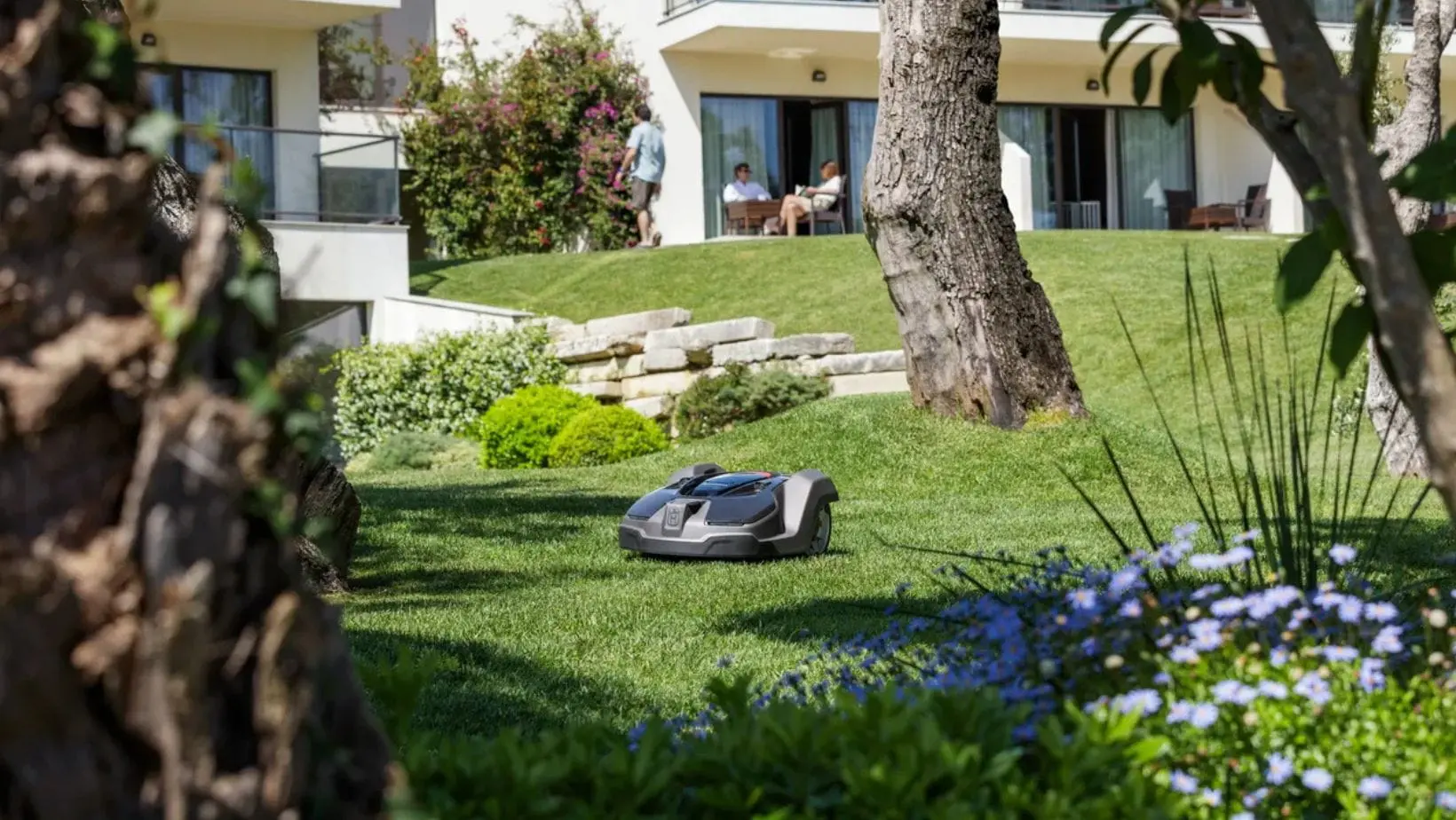
RTK robot mowers work without boundary wires and are ideal for complex, changeable gardens with good satellite coverage, especially when paired with a reference station. Wired robot mowers are often more reliable in shaded, enclosed gardens with trees, ponds, and narrow passages. Garden Machinery Direct sells both types of machine, and can offer expert advice to help you decide which is best for your lawn.
Should I Buy a Wired or RTK Robot Mower for a Complex Garden?
Robot mowers have come a long way from their early days of being simple, wire-guided machines quietly trimming straightforward lawns. Today, they’re tackling far more demanding spaces — gardens with sweeping borders, mature trees, ponds, sheds, greenhouses, and even lawns split into disconnected sections. As a result, choosing the right technology matters more than ever.
Two main approaches dominate the market in robot mowers: those that rely on physical perimeter wires and newer models that use RTK positioning to operate with virtual boundaries. Both systems can work brilliantly, but they suit different types of complex garden in very different ways.
Here, we explain what RTK technology is, how it works on robot mowers, and how it compares to traditional wired systems when used in feature-rich, challenging gardens. We’ll also take a look at the benefits of buying an RTK reference station, if you decide to go down the wire-free route. So, if you’re weighing up a robot lawn mower without perimeter wire against a more established wired option, please read on and we’ll help you reach the right decision…
What Is RTK Technology on Robot Mowers?
 RTK stands for Real-Time Kinematic, a positioning technology originally developed for surveying, agriculture, and autonomous vehicles. When applied to robotic lawn mowers, RTK allows the machine to determine its position with extraordinary accuracy — typically within a few centimetres.
Standard GPS can be out by several metres, which simply isn’t precise enough to define lawn edges, borders, or no-go zones. RTK dramatically improves this by using correction data from a fixed reference point. This may be a reference station installed at your property or a cloud-based RTK network, depending on the mower.
The technology works by the robot mower constantly comparing satellite data with the correction signal, allowing it to calculate its exact location in real time. This precision is what makes a robot lawn mower no boundary wire setup possible. Instead of following a physical cable, the mower operates within digitally mapped boundaries set via an app.
For many homeowners and businesses, this is incredibly appealing. A robot lawn mower without boundary wire offers increased flexibility and a clean installation without trenching or cable-laying.
Traditional Boundary Wire Systems Explained
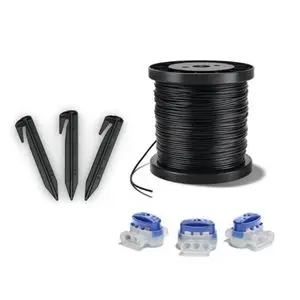 Before RTK arrived, almost every robotic mower relied on a robot mower perimeter wire. This cable is installed around the edge of the lawn and around any obstacles such as trees, ponds, or flower beds. The mower detects the signal from the wire and uses it as a reference to stay within its working area.
In complex gardens, multiple loops and guide wires are usually required. For example, a robotic mower boundary wire might surround a pond, while guide wires help the mower travel between front and rear lawns.
Although it takes time to install, this approach has proven reliable for many years. Brands such as Husqvarna have refined the system extensively, and the Husqvarna Automower boundary wire setup remains a benchmark for consistency.
Complex Gardens: Why the Technology Choice Matters
A ‘complex’ garden isn’t defined by size alone. It’s about layout, features, and how they interact with navigation technology. Typical challenges include:
- Curved borders and planting beds that change over time
- Mature trees creating shaded or enclosed areas
- Ponds and water features requiring absolute boundary reliability
- Garden buildings, walls, and narrow passages
- Disconnected sections of lawn linked by paths or driveways
These features place very different demands on a robot lawn mower boundary wire system compared to a robot mower without perimeter wire.
RTK Robot Mowers in Complex Gardens: Pros and Cons
Let’s take a look at the benefits and challenges of using a robot mower no perimeter wire setup in a feature-rich garden.
Advantages of RTK Robot Mowers
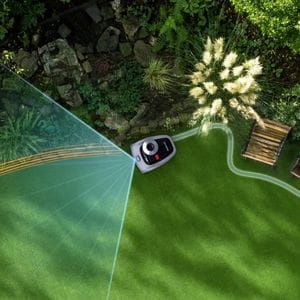 One of the biggest advantages of RTK is flexibility. For a robot lawn mower without perimeter wire, boundaries and no-go zones are created digitally. If you reshape a border, add a raised bed, or want to protect a seasonal feature, adjustments can be made in minutes via an app rather than by moving cables.
RTK mowers also excel at systematic mowing. Thanks to precise positioning, they can work in neat patterns, reducing overlap and improving efficiency. In larger, multi-zone gardens, this often results in quicker coverage, increased capacity, and a more uniform finish.
Disconnected lawns are another area where RTK shines. Zones can be defined separately, and the mower can be instructed how to move between them — sometimes even being carried between areas without confusing the system. If you’re looking for the best robot lawn mower without perimeter wire, having this level of control is a major draw.
Finally, installation is cleaner. There’s no digging, no need to bury wire for robotic mower systems, and no risk of accidental cable cuts during aeration or landscaping.
Limitations of RTK in Challenging Layouts
RTK, however, relies on satellite visibility, and gardens with heavy tree canopies, tall buildings, or narrow ‘corridors’ between walls can interrupt the signal. In these environments, a pure robot mower no boundary wire system may struggle unless it’s supported by additional sensors such as AI cameras or LiDAR.
Accuracy during setup is also critical. Mapping boundaries requires care, particularly near ponds or drops. While RTK can be extremely precise, errors in initial mapping can have consequences, so professional installation is usually recommended.
There’s also more technology involved overall. Reference stations, connectivity, and software updates mean RTK systems can sometimes become more complicated than simple perimeter wires.
Boundary Wire Robot Mowers in Complex Gardens: Pros and Cons
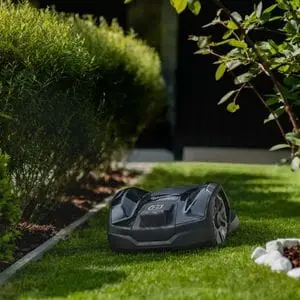
Some people have a tendency to dismiss robotic mower boundary wire systems as the inferior option, for anything other than small, basic lawns. This is wrong. Just like robot lawn mowers without perimeter wires, these machines have their pros and cons.
 Strengths of Physical Wires in Difficult Environments
A well-installed robot lawn mower perimeter wire remains one of the most reliable ways to define boundaries, especially in gardens with poor satellite reception. Trees, sheds, and walls have little effect on the mower’s ability to detect the cable.
For water features such as ponds, a physical loop offers peace of mind. Once an island loop is installed, the mower will not cross it, regardless of weather, shade, or signal quality. In gardens where safety margins matter, this predictability is hard to beat.
Boundary wire systems also handle narrow passages well. Guide wires can lead the mower through tight gaps between buildings or hedges, something that can challenge satellite-based navigation systems.
Drawbacks of Wired Robot Mowers in Complex Gardens
The biggest downside to lawn mower boundary wire is inflexibility. If you change the shape of a lawn or move a border, the perimeter wire for robot mower setups must be adjusted physically too. In gardens that evolve over time, this can become frustrating.
Installation itself can be time-consuming in complex layouts. Routing a lawn mower boundary wire around multiple features requires careful planning, and mistakes can lead to weak signal areas or unreliable behaviour. This makes professional installation an absolute must.
There’s also ongoing vulnerability. A robot mower wire can be damaged by gardening tools, pets, rodents, or ground movement, leading to fault-finding and repairs.
Disconnected Lawns: Which System Handles Them Better?
Disconnected lawns are common in larger or more traditional gardens. Wired systems can handle this using guide wires or by creating separate loops, but installation becomes more involved and less elegant.
RTK systems approach this digitally. Each lawn area can be defined as its own zone, making robot lawn mowers without perimeter wires 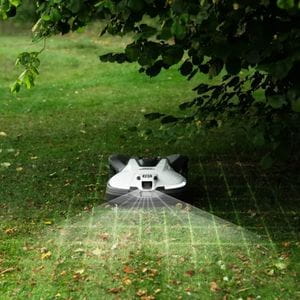 particularly appealing in these circumstances. So, if you’re looking for a lawn robot no wire solution that adapts to multiple areas, RTK is often the simpler option — provided signal conditions are suitable.
Which Is Better for Your Complex Garden?
Unfortunately, there’s no universal answer. For gardens with good sky visibility and regularly changing layouts, a robotic lawn mower without boundary wire offers unmatched flexibility and convenience. These machines are ideal for modern gardens with open spaces, evolving designs, and multiple zones.
For heavily shaded gardens with dense trees, narrow passages, or high-risk features like ponds, a robot mower perimeter wire system may still be the safer, more predictable choice. In these environments, physical boundaries remove uncertainty.
The Benefit of EPOS™ Reference Stations for RTK Robot Mowers
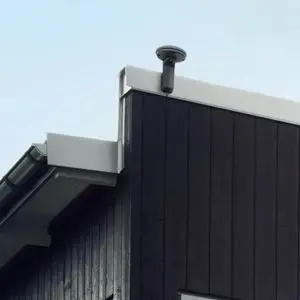 If your heart is set on a robot lawn mower no perimeter wire setup, but you’re concerned about how it will cope in a garden with poor satellite signal, you should consider buying a dedicated RTK reference station.
These reference stations, like the Husqvarna EPOS™ RS1 and Husqvarna EPOS™ RS5, are installed in a fixed position with a clear view of the sky, often on a building, pole, or dedicated mounting point. Because their location is precisely known, they continuously transmit correction data to the robotic mower, compensating for satellite drift and signal inconsistencies caused by nearby obstructions. In effect, the mower is no longer relying solely on raw satellite data, but on a constantly refined positioning signal tailored to your garden.
In complex gardens with trees, sheds, or narrow lawn corridors, this correction data will significantly improve positional stability, helping the mower maintain accurate virtual boundaries even where satellite reception might otherwise fluctuate. When combined with onboard sensors, EPOS™ reference stations allow wire-free robotic mowers to work more confidently around borders, no-go zones, and delicate features such as ponds.
This makes a no boundary wire robot mower much more accurate in a challenging setting. Buying a reference station can be the difference between occasional signal drop-outs and consistently precise, professional-level performance.
 Buy Robot Mowers with Expert Advice from GMD
Whether you’re drawn to a cutting-edge robot mower without boundary wire or prefer the reassurance of a traditional robotic mower boundary wire, choosing the right machine starts with having the right options.
At Garden Machinery Direct, you’ll find Britain’s best range of robot mowers for sale. From advanced RTK models to trusted wired systems, we sell the leading solutions for both simple lawns and more complicated garden layouts. With expert advice, leading brands, and machines suited to every scenario, we’re the best place to find a robot mower that’s the perfect fit for your garden.