
TLDR: Regularly inspect and clean your chainsaw, follow safety steps (engine off/chain brake; unplug/remove battery), sharpen chain every ~4 hours, deburr and tension the bar, keep chain oil topped, and for petrol models drain or use stabiliser when storing.
How to Maintain a Chainsaw and Keep It Running Smoothly
Few garden tools work harder than chainsaws, so they need to be properly looked after. Effective chainsaw maintenance encompasses tasks that need carrying out whenever you’ve used the tool, as well as those that are only done periodically.
Here, we provide a rundown of all the basic chainsaw maintenance tasks, to help you keep your chainsaw in tip-top working condition.
Chainsaw Safety Advice
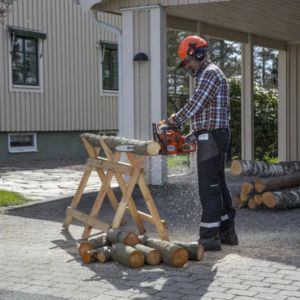 Naturally, before carrying out any of these chainsaw maintenance jobs, you must ensure the tool is safe. For petrol chainsaws, this involves turning off the engine and applying the chain brake. With electric chain saw maintenance, it means unplugging the tool. And for cordless chainsaw care, you should remove the battery and apply the chain brake.
Routine Chainsaw Checks
Because of the demanding nature of cutting through thick pieces of wood, chainsaws need checking both before and after use. This should help you nip any potential problems in the bud.
Start with a general visual inspection, looking for signs of damage on the tool and its controls. Ensure the guide bar, saw chain and other key parts are secure and correctly fitted. Test the throttle trigger, stop switch and chain brake, as well as the condition of the saw chain. Ensure the tank caps are properly sealed and that there isn’t any fuel leaking from the tool.
The findings of your visual inspection will determine exactly what maintenance tasks need carrying out at that moment in time.
 Chainsaw Cleaning
Chainsaw cleaning is an absolute must whenever you’ve used your chainsaw because there will inevitably be wood shavings and sap that need cleaning off the tool. The benefit of regularly cleaning your chainsaw is that it prevents the accumulation of dirt, which helps optimise the chainsaw’s performance and increase its lifespan.
In terms of the housing, just like with any other garden machine, you can clean it with a damp cloth. In the case of cordless chainsaws, you should clean the battery casing this way too.
To reduce the risk of the chainsaw overheating, you must clean the air intake slits. This can be done using a paintbrush or air compressor. Also pay attention to the oil inlet and bar groove, which can be cleaned with a round file or thin screwdriver.
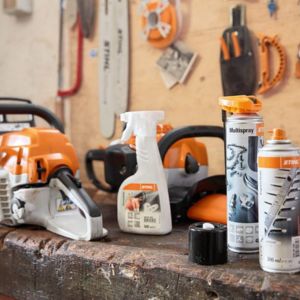
From time to time, the guide bar, saw chain and area around the sprocket are all prone to getting covered in stubborn dirt. In these cases (which includes chainsaw chain cleaning), use a specialist cleaning solution. There are plenty on the market and, for STIHL chainsaw maintenance, we recommend this one.
 Sharpening the Blades
Keeping your chainsaw’s blades sharp isn’t just essential to ensure they efficiently cut through the wood, it also helps minimise the risk of uneven cuts and dangerous kickbacks.
Blades tend to need sharpening after roughly four hours of use. Telltale signs are that smoke appears when cutting, the chainsaw vibrates more than usual (or pulls to one side), and a fine dust is generated when cross cutting.
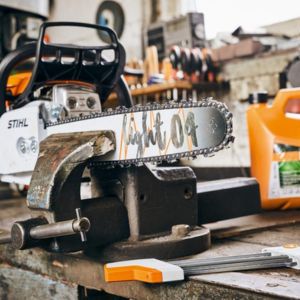
Before carrying out chainsaw blade maintenance, stabilise the chainsaw on a firm, level surface. Be sure to use the correct size of file to match the blades on the chain. (This information will be included in your chainsaw’s instruction manual.)
Then, using the file and a file guide, sharpen each tooth with two or three smooth strokes, each time pushing away from your body.
If you want to make the job as easy as possible, why not buy STIHL saw maintenance two-in-one EasyFile?
 Chainsaw Bar Maintenance (Deburring)
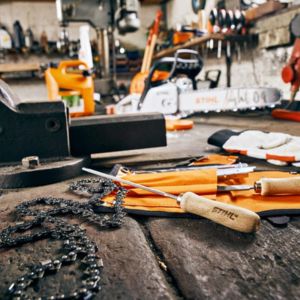
Burrs are deformations that appears on a tool’s fine metal edges after periods of heavy use. An example of a burr on a chainsaw might be a small indentation on the side of the metal bar, causing it to fold slightly, when it should be straight.
At regular intervals, or if you recognise signs of burring, remove the guide bar and saw chain from the housing. Clean both parts and, on closer inspection, if burrs have developed on the guide bar, carefully remove them using a flat file.
 Check the Chain Tensioning
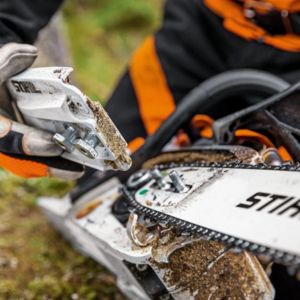
A correctly tensioned chain should fit snugly at the underside of the guide bar but should still have enough slack for you to freely pull it away from the bar before it snaps back into place. If this is not the case, you’ll need to carry out some chainsaw chain maintenance for the tool to remain safe and effective.
To tighten a chainsaw’s chain, firstly turn off the engine, remove the battery or disconnect the power supply (depending on the type of chainsaw). Then, with the chainsaw placed on a firm, level surface, release the chain brake.
Next, loosen the wing/ fixing nut(s) and lift up the guide bar. Tighten the chain by turning the adjustment wheel/ tensioning screw in a clockwise direction. Then, tighten the wing/ fixing nut(s) and let go of the guide bar.
Finally, check the chain is correctly tensioned by making sure it can be freely moved, but still fits snugly to the bottom of the guide bar.
 Keep Your Chainsaw Well Oiled
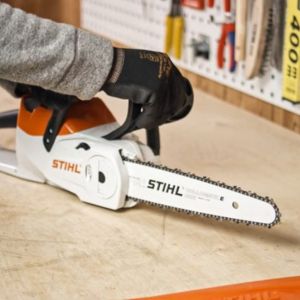
Regardless of the type of chainsaw, it’s essential that you closely monitor the chain oil because it prevents friction developing between the chain and guide bar. This, in turn, keeps the chain moving at optimal speed and prevents the tool from overheating. So, if you don’t keep your chainsaw well oiled, you’re going to encounter problems.
Unless your chainsaw has a transparent tank, it’s good practice to take a bit of time to regularly check the chain oil level – in the case of petrol chainsaws, this should be every time you refuel.
Early indications that your chainsaw isn’t getting enough oil include visible wear on the bar and chain, substandard levels of performance, and oil leaks.
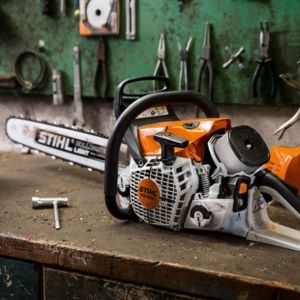 Looking After the Fuel Tank (Petrol Chainsaws Only)
Unless your chainsaw is used regularly, it is likely that the petrol inside the tank will gradually break down. This will eventually block the carburettor and so damage the chainsaw. When the chainsaw is in storage, this can happen within a month.
For the above reason, you should consider how much you’re going to be using the chainsaw in advance of adding the petrol, and then fill the tank accordingly.
If the chainsaw will be in storage for more than a few weeks, we advise emptying and cleaning the fuel tank. After draining the fuel tank, run the machine in idle until the engine cuts out.
Another option is to add a fuel stabiliser, like this one, to the petrol. This will help preserve its integrity and prevent it from deteriorating, along with cleaning and protecting your chainsaw’s engine.
 Britain’s Best Range of Chainsaws for Sale
Here, at Garden Machinery Direct, we stock an unbeatable range of chainsaws for sale. This includes cordless, electric and petrol models, brought to you by the world’s leading manufacturers of chainsaws.
And if you’d like to find out more about any of our chainsaws or have specific questions relating to the maintenance of a particular model, please don’t hesitate to contact one of our friendly, UK-based Garden Machinery Experts, who will be delighted to assist you in any way they can.